
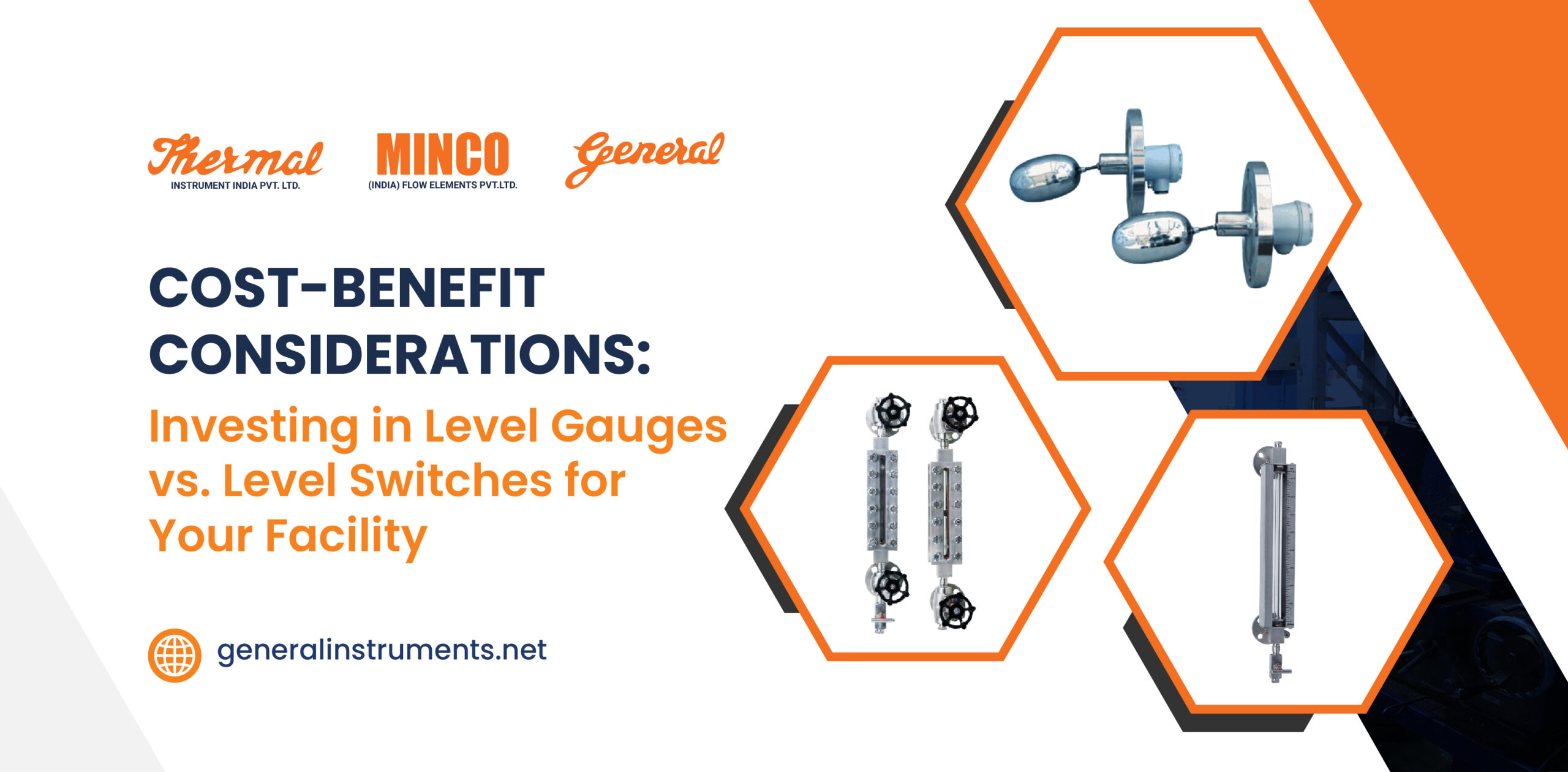
Cost-Benefit Considerations: Investing in Level Gauges vs. Level Switches for Your Facility
Understanding the Role of Level Measurement
In process-driven industries like oil & gas, chemicals, and water treatment, level measurement plays a vital role in ensuring safe, efficient, and uninterrupted operations. Choosing between level gauges and level switches may seem like a technical decision, but it’s also a strategic investment. At General Instruments Consortium, we offer advanced solutions for both, engineered to meet diverse industrial needs. The selection between a level gauge or a switch must account for not just functionality, but also installation effort, lifecycle cost, maintenance, and application fit.
Level Switches: Efficient and Economical for Point-Level Detection
Level switches provide point-level detection, meaning they signal when the liquid in a tank or vessel reaches a specific high or low point. They are ideal for straightforward tasks like preventing overflow, activating alarms, or starting/stopping pumps. Switches offered by General Instruments Consortium, including external chamber and top-mounted variants, are engineered for durability and minimal maintenance.
Their biggest advantage lies in simplicity—easy installation, low initial costs, and reliable operation even in rugged conditions. For basic process automation or applications where full level visibility is not required, level switches present a cost-effective solution. Their design also isolates the sensing mechanism from the process fluid in many models, improving service life in corrosive or high-pressure environments.
Level Gauges: Precision, Visibility, and Process Control
Level gauges, including reflex, tubular, and liquid level gauges, provide a continuous visual indication of fluid level. This feature is critical when processes demand real-time monitoring and granular control. Although gauges generally require a higher upfront investment due to materials, mounting accessories, and installation time, they offer significant long-term benefits.
General Instruments Consortium manufactures level gauges that provide operators with a clear, direct indication of the process level—especially valuable during calibration, inspection, or operations that demand accuracy. For industries operating under strict quality or regulatory guidelines, the visibility and precision of a level gauge help prevent costly errors, product waste, or downtime due to manual misjudgment.
Installation Considerations and Site Readiness
One of the key differentiators between level switches and gauges is the complexity of installation. Level switches are usually compact and quick to deploy, often needing only minimal piping modifications. This is particularly beneficial for facilities that need to minimize downtime or are installing instruments during a shutdown window.
In contrast, level gauges require careful mounting, especially for types involving glass tubes or flanges. Additional factors like pressure class, material compatibility, and accessibility must be considered during installation. While this adds to the initial project timeline and cost, the long-term stability and precision of level gauges often outweigh the effort required at the beginning.
Operational Reliability and Maintenance
Maintenance is an important factor in any instrumentation decision. Level switches, especially non-contact or external chamber types, demand very little attention once installed. They are often selected for remote sites or unmanned stations where routine checks are limited.
Level gauges, however, involve periodic cleaning, especially in applications prone to scaling, sedimentation, or chemical residue. Yet, their advantage lies in uninterrupted process insight. Visual gauges provide clarity in real-time—no calibration needed, no batteries or electronics to fail, just dependable performance under pressure. When process safety or accuracy is paramount, these instruments serve as both control tools and visual verification systems.
Matching Instruments to Application Needs
Not all applications are created equal, and selecting the right instrument type begins with understanding your process. For clean liquids, standard top-mounted switches may suffice. For turbulent, viscous, or aggressive fluids, General Instruments Consortium provides robust chambered switches and high-grade stainless steel gauges.
In environments like chemical plants or power stations, where tank levels must be monitored continuously, reflex or tubular gauges offer not only visibility but also adaptability with drain valves, isolating cocks, and other accessories. Meanwhile, point-level switches remain highly effective in batch processing, low-cost installations, or simple safety cutoffs.
Financial Perspective: Upfront vs. Lifecycle Value
While switches are more affordable upfront, gauges offer better total cost of ownership in many long-term applications. Level gauges help reduce process interruptions, improve product quality, and enhance safety—costs that may not be immediately visible but can be significant over time.
The initial cost of a reflex or tubular gauge may include fittings, valves, spacers, and higher-grade materials. However, the real savings come from the reliability and clarity they offer. Avoiding just one instance of overflow, shutdown, or regulatory non-compliance can easily recover the investment in a high-quality gauge.
Conclusion: Making the Right Investment
The decision between a level gauge and a level switch is not just technical—it’s strategic. If your facility requires basic alarms or threshold control with limited monitoring, level switches are a smart, economical choice. However, for operations where accuracy, visual feedback, and process visibility are critical, investing in a high-performance level gauge from General Instruments Consortium offers unmatched value.
Our engineering team can assist in evaluating your exact process parameters, installation environment, and regulatory requirements to help you make the most cost-effective and performance-driven choice. With decades of expertise, global certifications, and a legacy of innovation, General Instruments Consortium is your trusted partner in level measurement.