
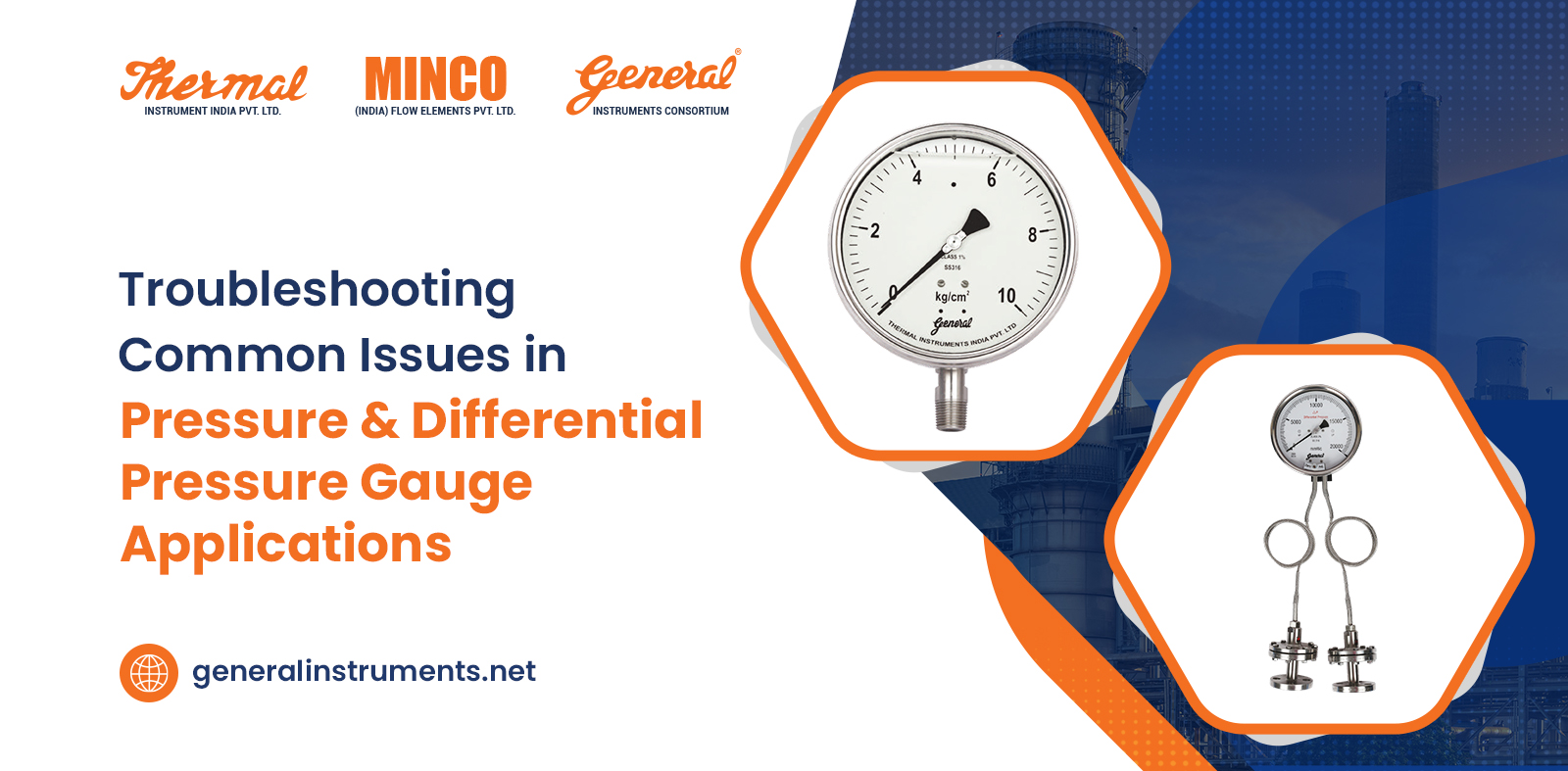
Troubleshooting Common Issues in Pressure & Differential Pressure Gauge Applications
Reliable pressure and differential pressure readings are fundamental to keeping industrial processes stable and predictable. Whether monitoring critical lines, safeguarding equipment, or maintaining product quality, these gauges act as frontline indicators of system health. Even the most advanced instruments, however, can experience deviations caused by process variations, installation factors, or harsh operating environments.
As a trusted manufacturer, General Instrument Consortium designs every gauge with a strong focus on durability, precision, and long-term performance. Yet even the most reliable instruments benefit from a clear understanding of common field issues and troubleshooting practices—ensuring operators maintain consistent accuracy and dependable operation.
-
Inaccurate or Fluctuating Readings
Possible Causes:
- Pulsating or fluctuating process pressure
- Clogged pressure ports or lines
- Mechanical vibrations or shocks
- Overpressure beyond the gauge’s rated capacity
Solution:
Install pulsation dampeners or snubbers to stabilise readings. For vibration-prone areas, use liquid-filled gauges (LFBSPG models) that dampen pointer movement. Regular cleaning of impulse lines and ensuring proper pressure range selection also minimises inaccuracies.
-
Zero Shift or Calibration Drift
Possible Causes:
- Thermal effects on the Bourdon tube
- Mechanical strain due to mounting orientation
- Continuous overpressure or pressure spikes
Solution:
Ensure the gauge is mounted vertically and calibrated regularly. Select gauges with SS316L or Monel Bourdon tubes for high thermal stability. General Instrument Consortium gauges undergo thermal stability and endurance tests, ensuring minimum drift even under fluctuating temperatures.
-
Leakage or Case Damage
Possible Causes:
- Process fluid corrosion
- Excessive vibration or pressure surge
- Seal failure or improper tightening
Solution:
Inspect connections, threads, and seals routinely. Using all-stainless-steel internals and corrosion-resistant materials such as SS316 Ti ensures long-term durability. If frequent leaks occur, consider safety pattern gauges with blow-out backs and baffle walls, designed to vent pressure safely in case of tube rupture.
-
Overpressure or Fatigue Failures
Possible Causes:
- Operating pressures exceeding rated limits
- Frequent cyclic loading
- Sudden start-ups or shutdowns
Solution:
Choose gauges with higher overpressure safety margins and install pressure snubbers where pressure surges are common. The General Instrument Consortium models undergo rigorous endurance and overpressure tests, guaranteeing resilience under demanding process conditions.
Ensuring Long-Term Reliability
To achieve sustained performance from pressure and differential pressure gauges:
- Follow recommended installation guidelines (avoid mechanical strain, align correctly).
- Schedule periodic recalibration.
- Ensure environmental protection and proper mounting position.
When sourced from a reliable manufacturer like General Instrument Consortium, users gain access to proven designs, precision engineering, and robust testing that collectively minimise downtime and ensure measurement integrity.
Conclusion
Accurate pressure measurement is not just about instrumentation, it’s about reliability, safety, and process control excellence. By understanding and troubleshooting common issues proactively, industries can maximize uptime, maintain safety standards, and enhance system efficiency.
With decades of experience as a global pressure and differential pressure gauge manufacturer, General Instrument Consortium continues to deliver precision-driven, safety-tested instruments trusted by process industries worldwide.