
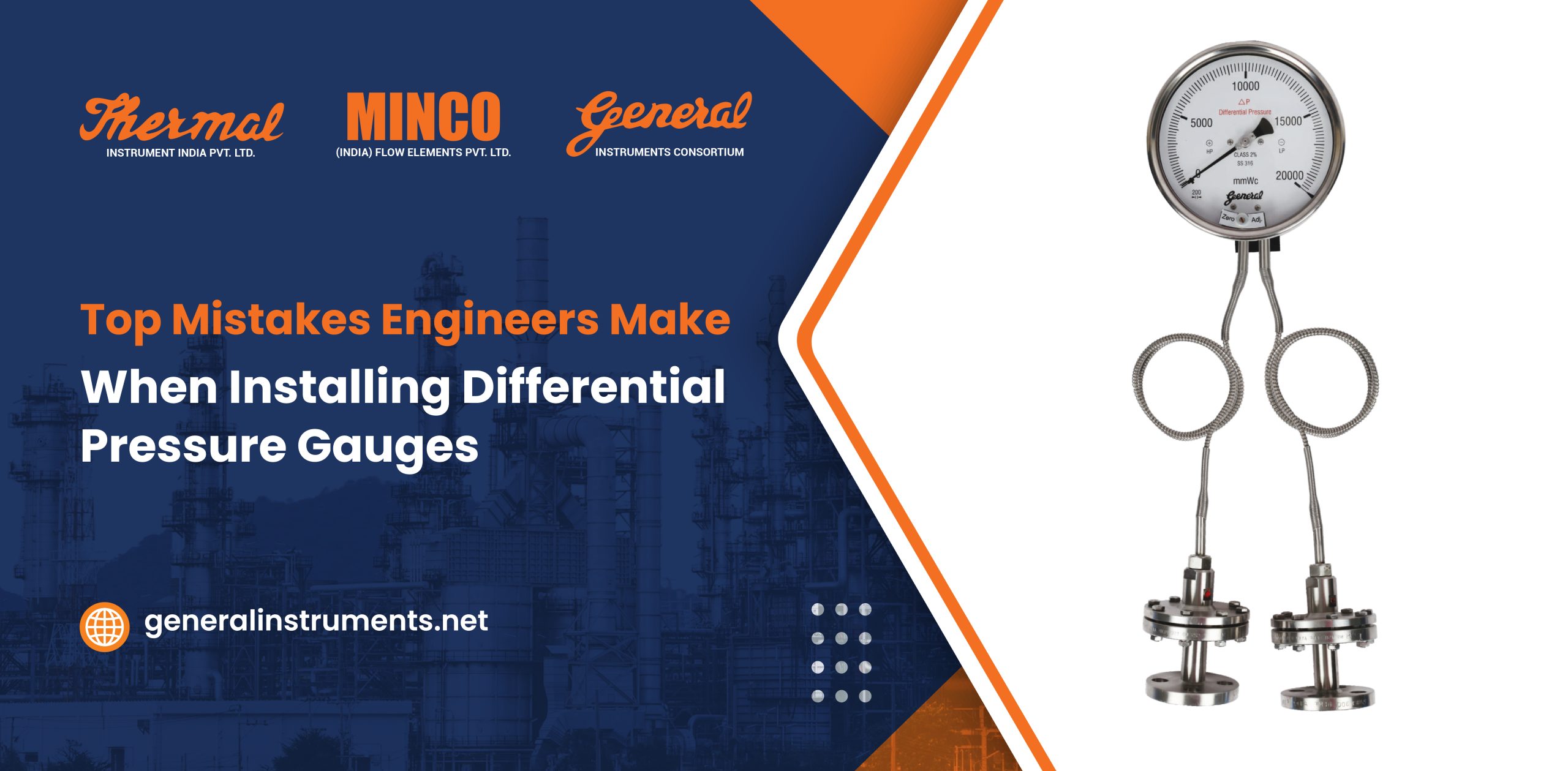
Top Mistakes Engineers Make When Installing Differential Pressure Gauges (and How to Avoid Them)
When it comes to accurate pressure monitoring in critical process applications, even minor installation errors can lead to major operational disruptions. As a leading manufacturer, General Instruments Consortium (GIC) has seen how improper installation practices often compromise the performance and lifespan of Differential Pressure Gauges – Bellow/Diaphragm Type.
These gauges—available in models like PG-B, DPG-D, LFDPG-B, and LFDPG-D—are engineered for precision, reliability, and long-term stability. Yet their accuracy depends as much on correct installation as on their robust design.
Here are the top mistakes engineers commonly make, and how you can avoid them.
-
Incorrect Orientation During Installation
Differential pressure gauges are highly sensitive to mounting position. Installing them at the wrong orientation leads to inaccurate readings and failure in field calibration.
How to avoid it:
Always follow the manufacturer’s recommended orientation. GIC’s DP gauges undergo tests for Influence of Mounting Position, ensuring performance, but correct orientation is still essential for accuracy.
-
Ignoring Compatibility With Process Media
One of the biggest installation oversights is connecting the gauge directly to corrosive or viscous media without checking material compatibility.
How to avoid it:
Choose the right unit with all-SS internals or add a chemical seal for aggressive media. General Instruments Consortium provides optional chemical seal units to ensure safe and reliable performance in harsh processes.
-
Overpressure During Commissioning
Engineers sometimes expose the gauge to full line pressure before ensuring proper equalization. This can permanently damage internal components.
How to avoid it:
Always use a proper three-valve manifold and equalize pressure before starting the system. GIC’s design allows each bellow/diaphragm to withstand full static pressure, but avoiding sudden overpressure increases longevity.
-
Poor Selection Between Bellow & Diaphragm Types
Choosing the wrong type—Bellow vs. Diaphragm—often leads to reduced sensitivity or unsuitable performance.
How to avoid it:
- Bellow Type (PG-B / LFDPG-B): Best for lower DP ranges and higher sensitivity.
- Diaphragm Type (DPG-D / LFDPG-D): Suitable for higher differentials and challenging process conditions.
Consulting the manufacturer in the selection phase ensures optimal performance.
-
Omitting Liquid-Filled Gauges in High-Vibration Areas
High vibration causes pointer oscillation and frequent calibration drift. Many engineers still install dry case gauges in such environments.
How to avoid it:
Use liquid-filled models (LFDPG-B / LFDPG-D) that reduce vibration impact. GIC’s gauges are tested extensively for mechanical vibration and shock, but filling provides added protection.
-
Neglecting Zeroing and Calibration Before Startup
Skipping basic pre-startup checks is one of the most common mistakes, leading to significant measurement errors.
How to avoid it:
Before pressurizing the system, ensure the gauge is properly zeroed and verified. GIC instruments undergo accuracy, hysteresis, and thermal stability tests, but final on-site tuning is still essential.
-
Using Long or Unequal Impulse Lines
Long, bent, or uneven impulse lines can cause delay, pulsation, or pressure drop errors.
How to avoid it:
Keep impulse lines short, equal in length, and free of blockages. Always slope lines properly to avoid fluid entrapment.
Why General Instruments Consortium DP Gauges Perform Better
As a global manufacturer, General Instruments Consortium ensures every gauge undergoes a full suite of rigorous tests, including:
- Visual & dimensional inspections
- Leak test
- Endurance tests for steady, over, and cyclic pressure
- Safety blow-out test
- Protection degree verification
- Effect of vibration & shock
- Thermal stability at rated temperature
With features like patented magnetic movement, all stainless-steel internals, and diaphragm/bellow designs that withstand full static pressure, GIC’s differential pressure gauges deliver accuracy and reliability across industries worldwide.
Conclusion
Selecting the right differential pressure gauge is only half the job—installing it correctly is what ensures long-term, reliable performance. By avoiding these common mistakes, engineers can drastically reduce failures, improve measurement accuracy, and extend instrument life.
Ready to Upgrade Your DP Measurement Accuracy?
Choose the trusted manufacturer, General Instruments Consortium, for high-precision Bellow and Diaphragm Type Differential Pressure Gauges engineered for demanding industrial environments.
👉 Contact General Instruments Consortium today to get expert guidance, product recommendations, or technical support.