
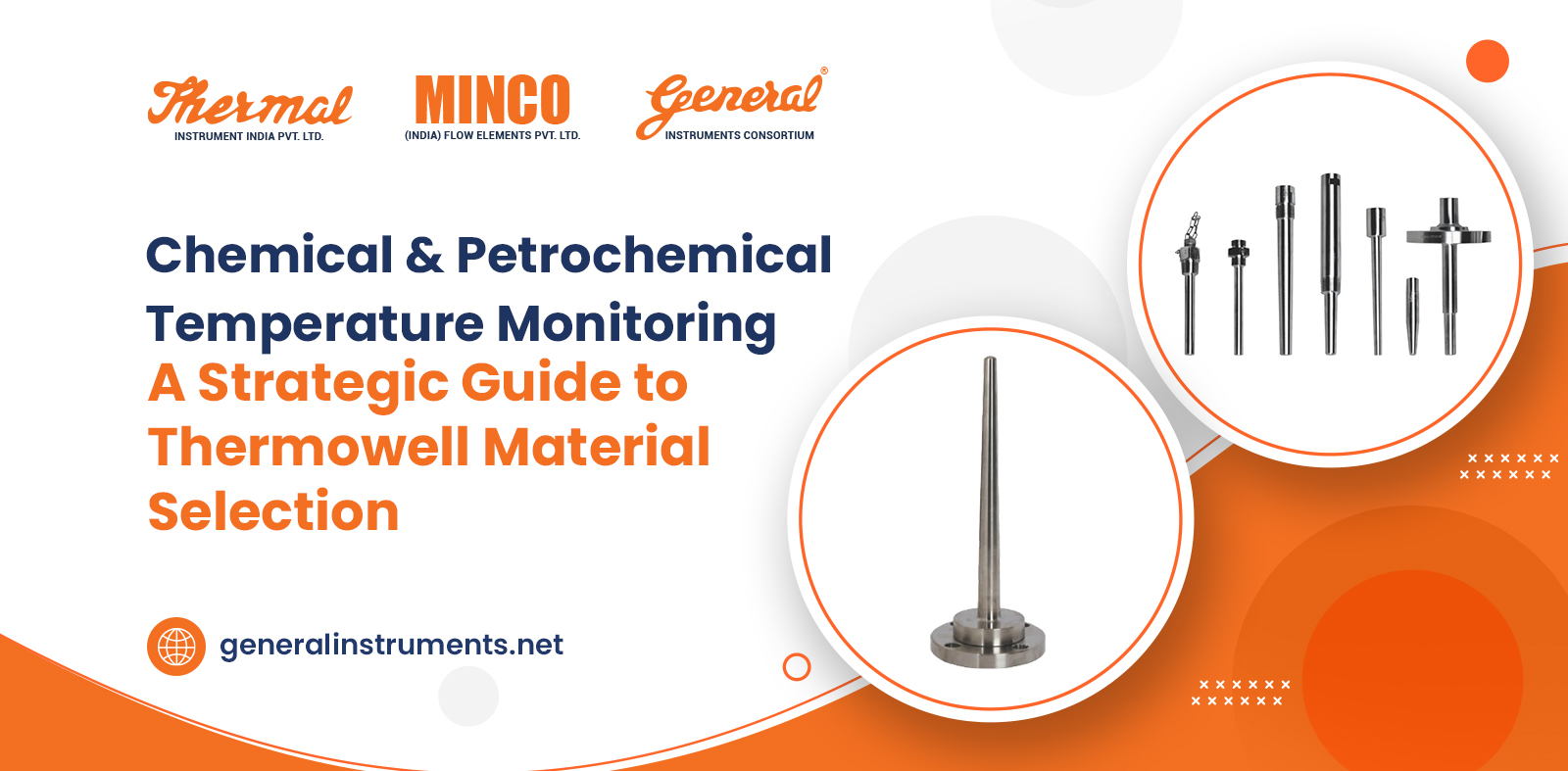
Chemical & Petrochemical Temperature Monitoring: A Strategic Guide to Thermowell Material Selection
In chemical and petrochemical operations, temperature is not just a process variable, it is a safety-critical parameter. From reactor stability and product quality to asset protection and regulatory compliance, reliable temperature measurement underpins every stage of plant performance. At the center of this reliability lies the thermowell, engineered to protect sensors while withstanding some of the most demanding industrial environments.
General Instruments Consortium, as a specialized thermowell manufacturer, designs thermowells that address the mechanical, thermal, and chemical realities of modern process plants.
This guide outlines how thermowell material and construction choices directly influence measurement integrity, operational continuity, and long-term asset reliability in chemical and petrochemical applications.
Why Thermowell Selection Is a Strategic Engineering Decision
Chemical and petrochemical services expose instrumentation to:
- Aggressive and corrosive media
- Elevated pressures and temperatures
- High flow velocities and turbulence
- Abrasive particulates and process erosion
A thermowell must therefore do more than house a temperature sensor. It must:
- Preserve measurement accuracy over time
- Maintain structural integrity under dynamic loads
- Minimize process intrusion while maximizing sensor protection
Material selection is the primary factor that determines whether these objectives are met consistently throughout the equipment lifecycle.
Thermowell Designs Engineered for Chemical & Petrochemical Service
General Instruments Consortium offers a comprehensive thermowell range, enabling engineers to match material and design to specific process challenges rather than relying on one-size-fits-all solutions.
Standard Thermowells – Balanced Performance for General Process Duties
Standard thermowells provide reliable protection for temperature sensors across a wide range of chemical applications where operating conditions are controlled and predictable. Their design supports dependable sensor isolation while allowing safe removal and replacement without interrupting the process.
Best suited for:
General chemical services where moderate pressure, temperature, and flow conditions are present and long-term measurement stability is required.
Vanstone Thermowells – High-Pressure Integrity Without Welding
In high-pressure lines and critical services where welding is undesirable or restricted, Vanstone thermowells offer a robust alternative. Machined from solid bar stock and installed between flanges, this design eliminates welded joints while ensuring mechanical strength and secure sealing.
Strategic advantage:
Improved serviceability and structural reliability in pressure-intensive chemical and petrochemical applications.
Helicoidal Thermowells – Engineered for High-Velocity Flow Stability
Flow-induced vibration is a common cause of thermowell fatigue and failure in high-velocity pipelines. Helicoidal thermowells, featuring a helical strake design, are engineered to disrupt vortex formation and reduce dynamic stress on the thermowell stem.
Strategic advantage:
Enhanced reliability and extended service life in turbulent or high-flow process streams.
Lined (Sleeved) Thermowells – Chemical Resistance Without Compromising Strength
Certain chemical environments demand enhanced corrosion resistance at the wetted surface. Lined thermowells combine a mechanically strong base material with a corrosion-resistant inner sleeve, offering targeted chemical compatibility while maintaining overall structural integrity.
Strategic advantage:
Optimized protection in chemically aggressive services without the cost or limitations of full exotic-material construction.
Ceramic / Hexalogy Thermowells – Stability at Extreme Temperatures
Ultra-high-temperature environments demand materials with exceptional thermal stability and resistance to chemical interaction. Ceramic and Hexalogy thermowells are designed for applications where metal alloys approach their performance limits, providing consistent protection and sensor stability at elevated temperatures.
Strategic advantage:
Dependable measurement in high-temperature process zones where conventional materials may fail.
Aligning Thermowell Material with Process Risk
Effective thermowell selection requires alignment with:
- Process temperature and pressure limits
- Flow velocity and turbulence characteristics
- Chemical composition and reactivity
- Maintenance and accessibility requirements
When material and design are correctly matched to service conditions, thermowells deliver:
- Longer sensor life
- Stable and repeatable measures
- Reduced maintenance intervention
- Improved operational safety
In chemical and petrochemical plants, this alignment directly translates into higher uptime and lower lifecycle cost.
The General Instruments Consortium Advantage
As a manufacturer focused on engineered temperature protection solutions, General Instruments Consortium provides thermowells designed around application-specific performance, not generic specifications. The breadth of designs, from standard and Vanstone to helicoidal, lined, tungsten carbide, and ceramic thermowells, enables precise customization for demanding process environments.
This application-driven approach ensures that temperature monitoring systems remain accurate, resilient, and dependable throughout long operating cycles.
Selecting the right thermowell material is a critical decision, not an afterthought.
Partner with General Instruments Consortium to evaluate your chemical or petrochemical temperature measurement requirements and deploy thermowell solutions engineered for long-term reliability and safety.
👉 Connect with our application specialists to define the optimal thermowell design for your process conditions.